Making Cents: How to Pay for Your Solar Array

Not long ago, two financial barriers prevented most households from going solar — even if they were ready to make the switch:

  1. The high price tag on solar arrays
  2. The lack of solar financing options available on the market

Thankfully, innovations in solar technology have made going solar more affordable than ever. In fact, the National Renewable Energy Lab estimates that the average price of a residential solar system has dropped by 64% in the last decade! All the while, solar technology has become more sophisticated. As a result, sites that were previously unsuitable for solar (such as east/west roofs or partially shaded areas) can now take advantage of the sun’s abundant energy.

Solar financing options have kept pace with the industry’s technological changes. Beyond traditional financing options (such as home equity loans), clients can now borrow from solar lenders that specialize in financing solar systems. These solar lenders have terms that eliminate the need for significant home equity or upfront cash when purchasing a solar system.

In short, clean, affordable solar energy is now more accessible than ever before. 

This article covers the most common solar financing options on the market, so you can decide which one will meet your unique financial needs. But first, let’s review why owning your array is so important in the first place.

Benefits of purchasing your solar array

Regardless of how you pay for it, owning your solar system maximizes your return on investment in both the short and long term.

In addition to boosting the value of your home right away, owning your solar system allows you to take advantage of the federal solar energy income tax credit during the next tax season. If you have taxable income, this credit will provide a dollar-for-dollar reduction in your federal income taxes equal to 26% of the total cost of your solar system — often amounting to a significant tax refund.

  • Tax credit example: If your solar system costs $30,000, you will receive a $7,800 tax credit the following year. This credit can be paid out in a lump sum (as a tax refund) or spread over multiple years to maximize your tax advantage.

In the long term, your system only becomes more valuable as it produces more free energy for your home. Rather than paying a revolving (and unpredictable) bill to your utility provider each month, owning your system allows you to make fixed monthly payments with guaranteed returns.

Other options for going solar (such as leasing a solar system or entering a power purchase agreement) might appear to save you money at first, but in reality, these arrangements just trade one utility bill for another. When you enter these agreements, the value of your home does not increase; in fact, the lease could be seen as an encumbrance by potential buyers if you attempt to sell your home. Additionally, you are not eligible for the federal solar tax credit, and any long-term gains from your system are diverted to your solar provider. Financially, these options just don’t stack up to the benefits of ownership.

Now that you know why it’s important to own your own solar array, let’s dive into how you can pay for it.

Traditional Solar Financing Options

Traditional solar financing options include home equity loans (HELOANs) and home equity lines of credit (HELOCs). To qualify for a HELOAN or HELOC, you’ll typically need at least 20% equity in your home, but specific requirements will vary from bank to bank.

Home equity loans are the most popular form of traditional solar financing. HELOANs are secured by your home equity, often resulting in lower rates than other types of loans. HELOANs function legally as a second mortgage, resulting in a lien on your home. These loans have fixed payments and a fixed rate, but you can lower your monthly payments if you re-amortize using the money from your federal tax credit refund. Doing so, however, means you will essentially be paying interest on the amount of your tax credit until you re-amortize. 

Home equity lines of credit are similar to home equity loans, but they offer more flexibility regarding when and how much you borrow. Rather than borrowing a single lump sum of money, a HELOC allows you to freely borrow against your home equity over a length of time known as the draw period (typically 5-10 years).If you anticipate other major expenses during the payoff period of your solar array (e.g. other home improvement projects, education expenses, etc.), it may make sense for you to open up this flexible line of credit. Unlike HELOANs, HELOCs have variable interest rates, potentially making them more expensive depending on market factors. 

Approval for both HELOANs and HELOCs takes about 2-4 weeks. The application process can be complex, often requiring:

  • A valuation of your property
  • A copy of your property deed
  • A copy of your mortgage statement
  • Income verification documents, such as pay stubs or tax returns

New Solar Financing Options

Until recently, traditional financing was the only option for households looking to go solar. Now, homeowners have a range of solar financing options to choose from thanks to the recent growth in solar loan programs. 

Solar loans do not require home equity, making them a more flexible and accessible option when financing your solar array. Solar loans are available from both traditional local credit unions and solar-specific lenders. 

Local credit unions

Many local credit unions have created unsecured solar loan programs designed around the unique tax credits involved with solar system purchases. These loans often start with low monthly payments with the expectation that you will apply your federal tax credit to your outstanding balance within 12-18 months. If you do not apply your full tax credit within this period, your monthly payments will increase. 

These solar loans tend to have higher interest rates because they are unsecured, but they may be a good option if you don’t have the home equity for traditional financing. Bear in mind, these traditional lenders may require a lengthy application, and the credit check will likely appear on your credit report. Additionally, your solar installer cannot adapt the terms of these loans to meet your financial goals. 

Solar-specific lenders

Solar loans from solar-specific lenders are very similar to those of local credit unions, but they tend to have a few special advantages. First, these loans are secured by the value of your solar system itself, allowing for lower rates than unsecured loans. This option is great for buyers without home equity to borrow against, but buyers with home equity may also prefer this option because it does not put a lien on their property like traditional financing would.

Moreover, solar-specific lenders have instant access to all the details about your new solar system, so they can typically approve you for financing in minutes, sometimes only requiring a “soft” credit check. This can save you days or weeks of waiting for approval compared to a traditional lender.

Finally, because these loans are facilitated through your solar installer, they can adapt the terms of your loan to your unique needs. For example, if you don’t want to apply your federal tax credit to your solar loan (or you’d prefer to spread your refund out over multiple years), you can design your loan to avoid the standard payment increase that most lenders would apply after 12-18 months. This is just one example of how you can customize your solar financing, but the flexibility of these loans means most clients can design a payment plan that works well for their goals and budget. 

Going Solar with Same Sun Has Never Been This Easy

Solar arrays are not one-size-fits-all — solar financing shouldn’t be, either. At Same Sun of Vermont, we only design customized solar arrays made with the highest quality materials available. Now, through our recent partnership with industry-leading solar lenders, we can also design customized solar financing packages that meet your unique goals.

If you’re ready to go solar with us, we’ve sweetened the deal this month with a special offer to celebrate our 10th year in business: Go solar with Same Sun this April and receive $1,000 off your custom solar array! To get started, give us a call at 802-775-7900, send us an email at info@samesunvt.com or Contact Us through this site.

What Size Solar Array Do You Need?

When going solar one of your main questions might be how large your array should be. You’ve probably seen homes with just a few solar modules, and also some with many more covering multiple roofs. What size do you need?

Ideally, your solar array will produce enough solar power to meet your energy needs throughout the year.

Sizing a solar array takes many factors into account – your usage, the solar resource at your location, what can physically fit on your roof, and your budget. 

Analyzing Your Electricity Consumption

When you think about your electricity consumption, you may use more in some months than others.  For example, you might have more summer usage because you are using air conditioning in your home or running a swimming pool.  Or, you might be using electric heat in the winter. A typical usage graph looks something like this:

Solar panels also produce different amounts of energy depending on the time of year–more in the summer due to the longer days. The good news is that the monthly values do not have to match exactly because of Net Metering. Net Metering allows solar customers to use their utility company as an energy bank. In this way, customers receive credit when an array is producing more than a household is using, like on long, sunny days, and drawing on those credits when the solar array is not producing enough to cover energy needs, at night or when it is rainy or cloudy. Therefore, we only have to consider your annual usage.

How Much Power Will your Solar Array Generate?

Many factors contribute to how much energy a solar array will produce, such as, how much shade an array will receive, if there will ever be snow covering the panels, weather, geography, and which direction the panels face. We gather this information during solar site evaluations using a state-of-the-art device, the SunEye 210, made by Solmetrics. You can read more about our process during Solar Site Evaluations here.

After a solar site evaluation, we input the information from the SunEye report into the PVWattsTM calculator. This calculator was created by the National Renewable Energy Laboratory to help solar installers estimate the performance of a solar array at a potential solar site.

The PV Watts report displays estimates of how much power an array is expected to produce over the course of a year using the variables entered in along with historical, local weather information to predict how many sunny, rainy, snowy and cloudy days are expected throughout the year. Then, we can adjust the number of panels in the proposed array until the amount of power expected to be produced covers the amount of energy a household needs based on their energy bill.

Designing the Array

Once we know how big the array needs to be, we move on to the fun part – designing the array. Using a special software, we can show customers a digital rendition of what the solar panels will look like either on the ground or on their roof. We use the images to make sure that the array will fit on the roof and that it looks good to the customer.

Sometimes customers cannot build an array that covers their entire energy consumption. This could be because they do not have enough space on their roof or ground, they don’t have enough shade-free area, or the upfront cost of a large array is simply too expensive at the time. Even if a customer cannot build an array that will cover their whole energy bill, going solar with a smaller array is still a smart option because it will still save them money and reduce carbon pollution.

Should I go Bigger?

Some customers wonder if there is a benefit to building an array that would produce more energy than what their electric bill suggests they would need. The answer is that it is sometimes advisable to build a larger array. One common reason for installing a larger array is if customers anticipate their energy needs will increase. Once customers decide to go solar, they often want to benefit from this new power source as much as possible by switching to electric appliances, electric heat pumps and electric vehicles. It is important to let your solar installer know if you are considering making these changes after you install a solar array so they can adjust their proposals to accommodate for this.

Another reason you may consider a larger array is if you have a place you can divert excess energy. With group net metering you can give your excess solar credits to anyone using the same utility company. Common places that customers will send their extra energy credits are rental properties they own, vacation homes, family members or their favorite local nonprofit.

We hope this discussion has helped to answer some questions about how we size a solar array. Because our work is always customized for your needs, the size will depend on how all of these factors apply to you. Please Contact Us, if you want more information or what to start the solar process.

Checking your Solar Array Production through Green Mountain Power’s Website

Once your solar array is installed, it is easy to forget about it until you receive your monthly utility bill, which now should be a much more pleasant experience thanks to the money you are saving with your solar panels. However, we recommend routinely monitoring your array’s production.  While most of the time your solar array will work as expected and you won’t experience any problems, occasionally glitches do happen. If you tend to only check your array when you look at your utility bill, an entire month may go by before you notice that your solar array is not producing or is under producing energy. Routinely checking how much power your array is producing and familiarizing yourself with monthly and daily averages throughout the year will enable you to spot potential problems quickly and easily. Responding quickly is the key to getting your solar array back up and running as soon as possible.

When monitoring your solar array’s energy production, you can use either your inverter manufacturer’s solar monitoring system or you can find the information through your electric provider using their online account platforms. The advantage of using the electric provider’s monitoring tools is that the kWh (kilowatt hours) they report are the exact numbers that you will be billed and credited for. Most of our customers have Green Mountain Power as their electric provider. Below we go step by step through the process of checking your solar array production using Green Mountain Power’s website. 

  1. Go to Green Mountain Power’s website – https://greenmountainpower.com
  2. Click on “My Account”
  3. Login using your Green Mountain Power login information. This step may not be necessary if you have remained logged in from previous sessions. Likewise, if you haven’t used GMP’s website before, GMP may prompt you to set up an account using your account # from your bill and the phone number used to set up your account.
  4. When the “My Account” page opens, you should see information about your account. If you scroll down the page a little bit you should see a chart that looks something like this:
This graph is showing your energy consumption, energy generation, and energy you returned to the grid for each of the last 12 months, plus the current month.

Chart Terms:

Consumed (Orange Bars) – The amount of energy your household or business pulled from the grid. This does not necessarily reflect how much energy was required to run your household during the given time period, as it does not count energy that you used from your array.

Generated (Dark Green Bars) – Total amount of energy produced by your solar array.

Returned (Light Green Bars) – The amount of energy produced by your solar array that was not consumed by your household, and therefore, was returned to the grid. This amount is recorded on your account as “excess generation.”

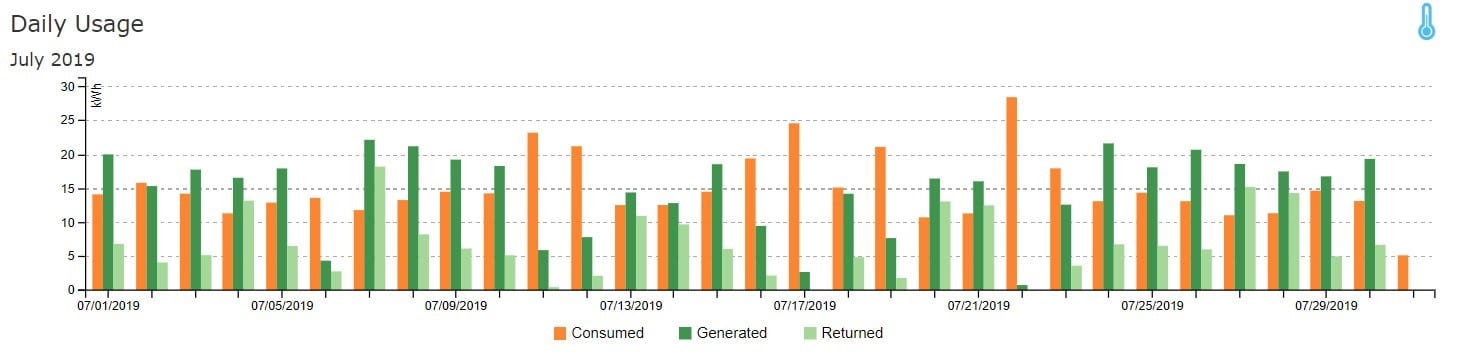
  1. Click on the bar for the current month and it will open a new graph that will look something like this:
This graph show the energy consumption, generation, and energy you returned to the grid for each day of the current month so far. (Please note there is at least a 24-hour delay on this data.)
  1. A few things to keep an eye out for are no production on days you know were sunny and if there is no production for several days in a row.

Keeping track of your production is the first step in ensuring that your solar array is producing clean energy year-round. If you notice a potential issue, call us. Same Sun of Vermont’s Solar ProFormance Services, LLC provides maintenance and repairs on existing solar arrays, servicing Vermont, New York, and New Hampshire. You can contact Solar ProFormance Services at (802) 775-7900. If you are outside of our servicing area, you can call the manufacturer of your inverter for a list of local solar companies that service your area.

Do I Have a Good Site for Solar?

In the wake of the current pandemic and the country switching to virtual meetings and contact-less delivery, you may be wondering why we can’t or won’t do virtual solar site evaluations. Like the rest of the world, we have had to adapt in response to our new reality and have made changes to ensure that our customers and our staff remain healthy. We only enter customer homes when necessary, we wear masks when in the vicinity of others, and have instituted new cleaning protocols. One thing we have not changed is the quality of service we offer. While we can, and do, gather a lot of information virtually, there is critical information we gather during a site evaluation. That critical information is what allows us to design the best solar array for your home or business. Here we look at what is involved during an in-person solar site evaluation.

During solar site evaluation we want to determine which areas on your property would make a “good” solar site. A “good” solar site is determined by a few factors. Generally, areas that experience minimal shading and face the equator (for us in Vermont, that is South), have the best solar resource.

To calculate these factors, we rely on a state-of-the-art tool called the SunEye 210. This SunEye 210, made by Solmetric, takes a series of measurements at each potential solar site, and provides us with much of the information we need in determining where we should build a solar array.

To do this, the SunEye takes a fisheye image of the skyline and superimposes a Sun Path Diagram to identify any shade-causing obstructions that would interfere with the amount of energy an array would be able to produce. Not only is the SunEye able to project the angle of the sun as it moves throughout the day, but it also projects the change in the sun’s location in the sky throughout the seasons.  The SunEye then instantly calculates how much the shading would impact the efficiency of the solar panels.

While you may think it easy to identify shading in an area, it can sometimes be quite tricky. For example, our Solar Consultant, Scott Stahler, described a time during a site evaluation when a house did not seem to have any shade in the vicinity to cause obstructions. Upon using the SunEye, he realized that the potential solar site had significant shading from nearby mountains during parts of the day and year! While a mountain is not an obstruction that could be removed, if shade is coming from nearby trees, the SunEye can help determine whether tree removal is worthwhile by simulating what the solar resource would be when they are gone.

If it turns out that your first-choice location for a future solar site is less than ideal, we can identify other potential sites. Often, people have ideal solar locations that they have not thought of. For example, perhaps there is an accessory building such as a barn, garage or guest house that can be used.

Or, you may have ideal land for a ground mount and not even realize it. We can help identify and evaluate multiple potential solar array locations.

We will also take roof and/or ground measurements to calculate the number of solar modules that can physically be installed. In this way, we can compare the size of the array and its anticipated generation with our evaluation of your current and future electricity consumption. For example, plans to install heat pumps or purchase an electric or hybrid vehicle will impact your usage. Look for a future blog post that will explain the methodology we use to design the array to fit your needs.

After we take all the measurements and gather the information we need, we will take some time to draw up a proposal for your future solar array. We custom design each system to meet your energy needs and ensure you will be happy with your array for years to come. If you have questions, or would like a solar evaluation done on your property, Contact Us today!

Summer Time and Going Solar is … Easy!

Are you interested in solar, but don’t know where to start?   Here are some of the ways we make going solar easy for you!

We make it personal!

  • It all starts with a phone call:  Simply call, or Contact Us through our website and we will call you.  A friendly advisor will ask you some questions, fill you in a bit about the process and how solar net metering works, and if it makes sense, schedule an in-person site visit. 
  • We will design a custom solar array to fit your needs:  One of our solar experts will meet you at your home or business, and gather the necessary information, including roof /ground measurements, sun and shade readings, and current and future energy needs. Following the site visit, we will design your custom array and present you with a proposal in no more than two days.  The price is always turnkey, so you will know exactly what your system will cost, and how it will offset your electric bill.
  • You will have access to everyone in our office:   This includes the owners, Philip and Marlene Allen, in the event you have concerns that are not being addressed.  Throughout the process, we are committed to you and are always available to answer technical, financial or other questions. Once your new solar system is installed, an executive from Same Sun will deliver all of your important documents and go over them with you, so you have everything you need in one place.

We do it all!

  • Filing all the documentation associated with solar can be a hassle: We file all the necessary paperwork, so you don’t have to. We handle everything from Net Metering Registrations and Building Permits to registering your products for Warranty Certificates.
  • We will be your advocate with your electricity provider:   We have years of experience working with Green Mountain Power and other utilities in navigating billing issues, advice for group allocation of solar credit, and scheduling any work that needs to be done, i.e. transformer upgrades.
  • We will minimize disruption to your life: Once you commit to a solar installation, we will schedule a Technical Site Visit with a Project Manager, who will not only verify the design and interconnection details, but work with you on aesthetics of the array and conduit, as well as best placement for both installed equipment and temporary lay-down/staging of components while we work.  After we’re done, our goal is to leave your property as we found it, i.e. thorough clean-up, re-seeding of lawn if necessary.

We’ll never leave you hanging!

  • We are committed to using quality products that stand the test of time:  We are constantly researching best practices and components that perform great and carry the best warranties.    
  • We have a dedicated Service Division:  In the case that anything ever does happen with your system, Solar ProFormance Services will be there to help.  This division of Same Sun is focused on solar panel repairs and replacements and is committed to keeping solar arrays in tip-top shape. More information on Solar Performance Services can be found here https://samesunvt.com/introducing-sps/

Going solar is one of the few major purchases you will make that pays for itself. After the initial investment, you will recoup the cost of the array and enjoy years of savings, money in your pocket – instead of the utility’s.  And if you buy in 2020, you may be eligible for the 26% Federal Tax Credit.

COVID-19 UPDATE:  Rest assured, we have modified all of our procedures – site visits, technical visits and installation practices – to ensure that they are safe.  We will minimize, or eliminate, the need to go inside your home wherever possible.   

Same Sun is Hiring!

Same Sun is looking for dedicated professionals to join our team. Based in Rutland, and operating statewide.

A resume, cover letter and a minimum of 3 job references are required for consideration. Please email to jobs@samesunvt.com.

PV Installation Foreman

The PV Installation Foreman’s primary job is to lead a crew in safely installing solar-electric systems to the highest level of quality and code compliance, follow plan sets and job specifications, and provide frontline customer service at the jobsite. While mostly focused on residential projects, the job will at times include small-scale commercial projects as well. Previous PV and/or building trade experience highly preferred.

Read the full job description here.

Solar Designer

The Solar Designer’s primary job is to support the Operations and Project Management teams by developing customer specific design packages, including basic site plans, one-line electrical drawings, array layouts and grid interconnection details. While mostly focused on residential projects, the job will at times include small-scale commercial projects.  Prior solar installation and/or design experience required.  NABCEP certification and/or Solar S-license (or equivalent state license) highly preferred.

Read the full job description here.

Solar+Storage Forum on the Green in Woodstock

SpectorHouse

On  Thursday, October 24th from 5:30 pm to 7:00 pm,  Same Sun of Vermont will be hosting a forum at 16 The Green, Woodstock, Vermont to showcase their installation of solar and battery backup system at this historic home, built in 1823. 

Elements specific to this unique property, as well as those common to all solar and battery storage installations will be explained, including:

  • a design that minimizes visibility in the center of the Village;
  • the process of informing the Design Review Board and the feedback we received; 
  • the environmental and financial benefits of solar power;
  • the costs and engineering of a battery backup system.

Light refreshments will be served, with a presentation from 6 pm to 6:30. 

If you can’t make it but know someone that is interested in solar, please pass this along.

Reservations are required; please email, call 802-775-7900 or use the Contact Us form on this website.

We look forward to seeing you!

Marlene & Philip Allen
Same Sun of Vermont, Inc.

Summer 2019 Promotion

Go Solar in 2019, Pay in 2021! Call now for a FREE site visit to reserve your custom solar installation. Enjoy no-payment, no-interest financing for 18 months; if your system is installed in the fall/winter of 2019, you will not have to pay until 2021. Take advantage of your tax credit and months of electric bill savings, before having to make any payment.

Front of Summer Promotion mailer
Back of Summer Promotion Mailer